Financial advice that starts with a plan.
We help you do more with what you’ve earned.
We get this question a lot. “Is now a terrible time to invest?” It’s a fair question. Everybody has something to lose if it actually is a terrible time to buy the market. Money.
We’ve had a number of clients and prospective clients express their fears recently as the U.S.-Iran war unfolded.
I get it. Things are kinda weird out there, especially with the 24/7 news cycle and social media algorithms feeding off of your fears. It’s easy to get caught up in the noise.
But from an investment perspective, things are not that bad. In fact, things look pretty normal. Downturns are normal. Market volatility is what a normally functioning market looks like.
I think part of the problem is that a lot of people conflate how they feel about the world with how they feel about their own portfolio. It’s important to remember that these are two different things. There will always be a crisis. There will always be uncertainty. And yes, geopolitics can affect market returns, but not always. And if they do, nobody knows to what degree or how long.
Don’t Get It Conflated
Let me begin by saying that the markets are not in freefall. Not even close.
As I write this, the S&P 500 is currently down 2% from its all-time high.
2%.
Most of our clients are positive for the year.
The S&P 500 hit its all-time high on January 27th. Since the U.S. began bombing Iran (my thoughts on this at the time) and when Iran closed off the Strait of Hormuz (my thoughts on this here), the S&P 500 experienced a total drawdown of about 10%. And it has already recovered most of that.
A 10% decline is not unusual. It is not even close to unusual.
I am also very aware that as I write this, the U.S. is enforcing a naval blockade of Iranian ports in the Strait of Hormuz. Ships that had been paying Iran a toll to pass through are now being turned away. The trickle of traffic that was getting through has essentially stopped. This situation can easily spiral, and the conflict risks dragging on.
This is where the conflation happens. The geopolitical situation feels like a 30%-40% event. The market is telling you it is a 10% event (currently 2%). Both things can be true at the same time. You can be deeply concerned about the state of the world and still be in a perfectly fine position as an investor. These are separate conversations.
Volatility is the Price You Pay
If you’ve followed me for a while, you know one of my favorite sayings: ‘Volatility is the price you pay if you want attractive returns.’ In other words, there is no free lunch. The markets are incredibly volatile in the short term, but an excellent wealth-building machine in the long term. You have to be willing to ride out the ups and downs for those returns.
Lately, I feel that investors have forgotten this lesson.
For the past 17 years, since the March 2009 lows, the S&P 500 has gained over 1,100%. That is an annualized return of over 16%. (!!)

In fact, the market has only experienced two down years during this timeframe: 2018 and 2022.

Charts like these show only annual returns, so they gloss over the intra-year declines, which are common. Since the March 2009 lows, there have been 32 instances where the market has fallen by at least 5%.
Even with those declines, the market usually finds a way to rally by the end of the year.
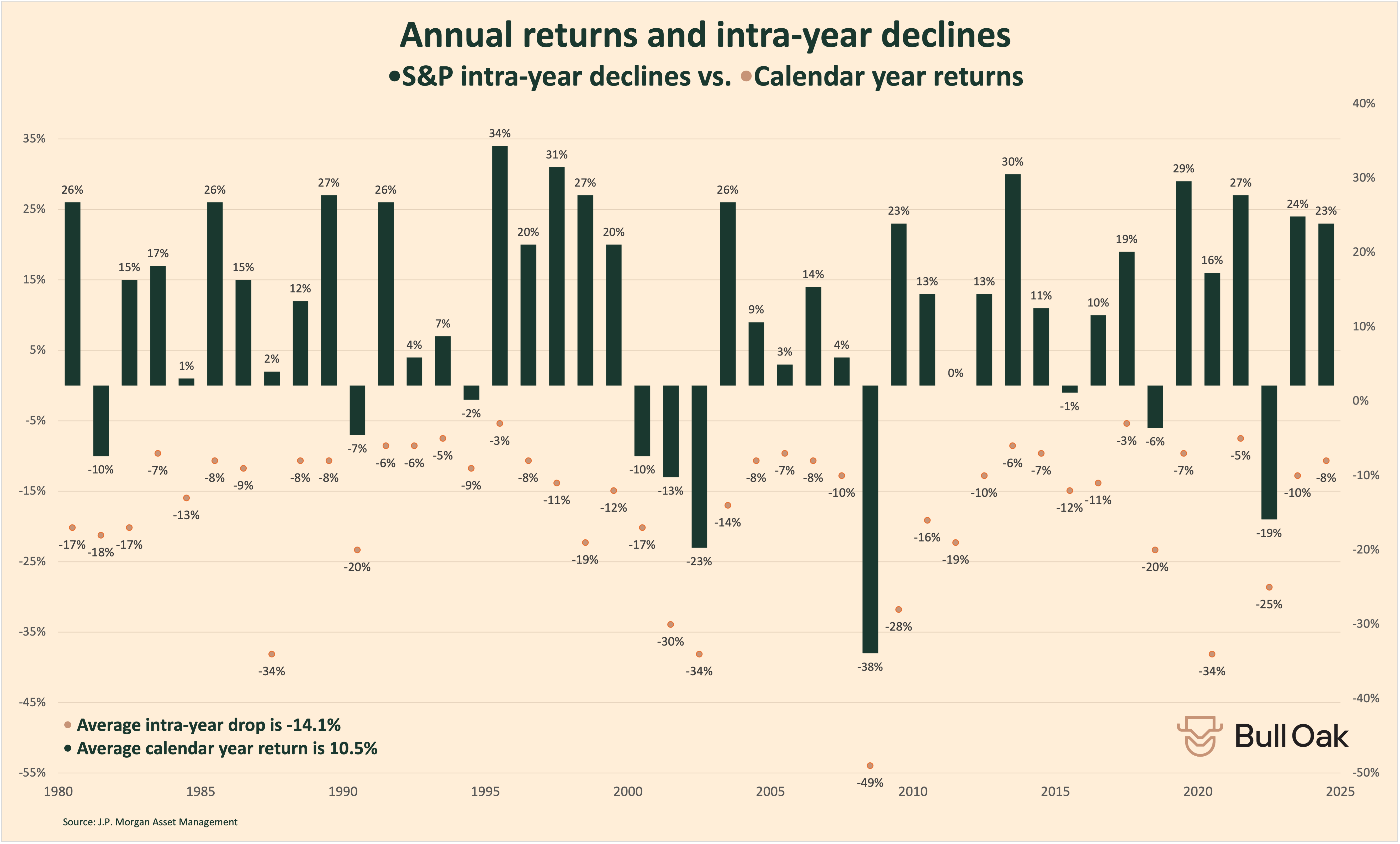
In other words, it is completely normal to experience market volatility. If the market is 5%-10% down from its all-time highs, your response should be: “This is nothing new. This happens all the time.”
To take things even one step further, if you are an equity investor, you should expect to log in one day and see your account down by 20%-30%. I know this sounds a bit dramatic, but it’s true. This is not an ‘if’ statement, but a ‘when’ statement. It will happen one day.
There will be a crisis of some sort. Business activity will falter. Profit margins will fall. Stock prices will decline. This story has been playing out since commerce began. The best thing you can do is prepare for it.
But know that, as with everything else in life, the crisis will pass. Business activity will recover, and everything will be fine.