
Financial advice that starts with a plan.
We help you do more with what you’ve earned.
One of my favorite stats to share with market-weary clients is that the average intra-year decline for the S&P 500 since 1980 is –14.1%. Think about that. During any given year, you should expect the market to fall on average by 14%.
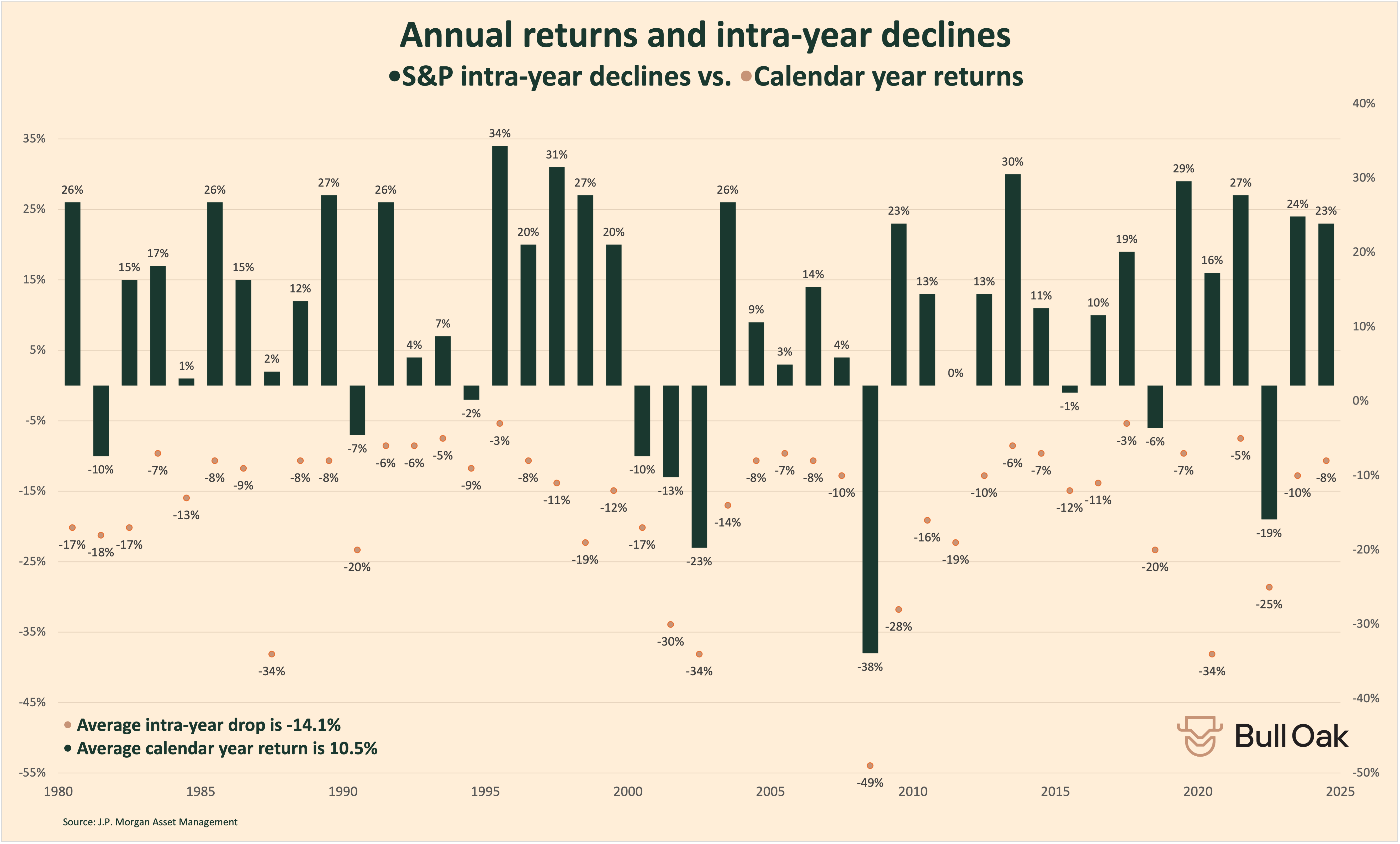
Of course, this average has quite the range: –3% to –49% (!!).
The –3% decline occurred both in 1995 and 2017. The –49% decline? 2008.
Of course, if you didn’t panic and stayed the course, the market would reward you. And despite an average intra-year drop of –14.1%, annual returns were positive for 34 of 45 years.
For those keeping track, the average calendar year return during this timeframe is 10.1%, perfectly in line with historical expectations.
All of this reiterates one simple fact–if you are an investor, you have to expect drawdowns in your portfolio. Volatility is the price you must pay if you want attractive returns. There is no other way around this simple truth.
How We Got Here: The Fall of the Blue-Collar Job
As I write this piece, the S&P 500 is down -8% from its all-time high. The primary driver of this pullback? Trump’s economic agenda, which is an effort to safeguard domestic industries and American jobs by reducing foreign competition.
The specific industries affected are:
- Steel and Aluminum: This has been a primary focus in an effort to shield American producers from cheaper imports.
- Automotive and Machinery Production: The idea here is that by making imported goods more expensive (via tariffs), American companies will be encouraged to produce domestically.
- Energy: Reduce reliance on imported energy and support jobs in the energy sector.
There has been a major hollowing out of blue-collar manufacturing jobs since the early 1980s. As globalization picked up steam in the 1980s, many manufacturing jobs shifted overseas to countries with lower labor costs. This led to significant job loss and wage stagnation here in the US. Communities declined, and economic inequality between blue-collar and white-collar workers only deepened.
These tariffs are an attempt to restore these types of jobs.
The Concern
The fear is that these policies will slow economic growth while driving prices higher. This may be the case—or it may not. We do not know what the economic fallout of these policies will be.
I am doubtful about the timeline for replacing the industries affected. The best estimates are 5–10 years (or longer), but who knows?
How quickly can these companies raise the capital needed to build these plants? How quickly can they retrain their workforce (or a new workforce)? What about any technological upgrades?
And the million-dollar question—what happens after Trump leaves office? And is it wise to spend hundreds of millions or billions of dollars if the new administration is going to free up trade again?
Closing
In the end, don’t panic. The market is always going to be volatile. Always. If you want the returns that the market provides, you have to be willing to ride these downturns. Keep a long-term perspective, and remember that your concerns today will pass in time.