Investment Management

How you invest your money is one of the most important decisions you will make on the path to financial freedom. A portfolio of index funds is a good starting point. But there is plenty more one can do: adding factor tilts like momentum and small-value, determining whether alternatives belong in your portfolio, screening out international exposure with serious geopolitical risk (E.g., China and Russia), and considering every portfolio decision to your tax return and financial plan. After all, portfolio returns are great, as long as they don’t derail your tax plan.

We have a clear investment philosophy, strong convictions about where to invest (and where not to), and a process that integrates your investments with your tax strategy and financial plan. Every decision we make with your money is rooted in data and connected to a bigger picture.

Our Investment Philosophy

We believe in owning the best assets in the world, keeping costs low, and investing with conviction. Our investment approach is built on four principles.

Growth Potential

We prioritize U.S. stocks above all else. Why? Because they’ve consistently been one of the best-performing asset classes over the long term. Most people know that large-cap stocks, such as the S&P 500, have performed well over time. Yet even within the S&P 500, there are pockets of excess return for those who know where to look.

There is a tendency for a handful of stocks already pulling ahead to continue to pull ahead. This is known as momentum, and decades of research confirm that equities with the strongest recent risk-adjusted price strength tend to outperform over the next several quarters. By tilting a portion of the portfolio toward a rules-based momentum strategy, we can systematically capture this for our clients.

We also allocate to small value stocks, both domestic and international. Small value has been one of the most well-documented return premiums in academic finance. These are smaller companies trading at lower valuations that have historically outperformed large growth stocks over long periods.

Momentum Stocks Outperform the S&P 500

Diversify & ETFs

While momentum and small value have delivered excess returns over long periods, we don’t know which asset class or factor will lead in any given year. Markets are efficient enough that making concentrated bets is a losing game over time. That’s why we diversify.

We diversify across asset classes, including US Stocks, International Stocks, US Government Bonds, International Government Bonds, Investment-Grade Corporate Bonds, High-Yield Bonds, Treasury Inflation-Protected Securities, Cryptocurrencies, and more.

It is important to note that we intentionally do not invest in Chinese or Russian stocks.

Many investors make big bets, often without knowing it, typically on a particular company, country, or asset class. By diversifying properly, we help our clients avoid this mistake. We rely heavily on low-cost, passive ETFs (Exchange Traded Funds) to accomplish this. ETFs are not only cheaper than actively managed mutual funds but also more tax-efficient, generating far fewer taxable events along the way. The average fund expense ratio across our portfolios is under 0.10%.

Buy When Others Are Selling

Bear markets can be unnerving, prompting many investors to sell their holdings in panic. However, these downturns are usually short-lived compared to the ensuing bull markets. Investors who sold during the early-2020 pandemic selloff, the 2022 rate-shock correction, and the 2025 tariff-driven pullback missed the recoveries that followed.

We buy during significant market weakness and leverage the wisdom of being contrarian. As Warren Buffett famously said, “Be greedy when others are fearful.” This means systematically buying stocks during market dips to benefit from the eventual upswing. Such a strategy aims not just for recovery but for capturing above-average gains by capitalizing on these inevitable cycles of market volatility.

Alternatives

We allocate a small percentage (usually 0%-5%) of client portfolios to alternative assets, including gold and bitcoin. These are not speculative bets, but rather serve a specific purpose in a diversified portfolio.

Gold is not always the inflation hedge most people think it is. We wrote about this in detail. During periods of high inflation, gold has produced negative real returns more often than not. But gold does serve a purpose. It is a store of value with thousands of years of history, it tends to hold up during periods of prolonged currency debasement, and it behaves differently from stocks and bonds.

Bitcoin is still a young asset class. We think of it as an awkward teenager. It is mature enough to be trusted in some situations, but it still has room to grow. In our view, Bitcoin will either continue to gain adoption or go to zero. There is no middle ground. We believe the former is more likely, but we size the position accordingly.

In an era when most major economies continue to expand their money supply at an unsustainable pace, we think a small allocation to assets outside the traditional financial system makes sense.

Where We Don't Invest

We do not invest in Chinese or Russian equities. The geopolitical risk, the lack of reliable financial reporting, the ethical concerns, and the regulatory unpredictability in these markets make them unsuitable. Our international equity exposure is limited to developed markets only.

Many investors (and advisors) hold broad emerging market index funds that include significant exposure to China without ever disclosing this to their clients. We think this is a problem and a significant risk that many have not fully priced in.

We also do not invest in anything that pays us a commission. Bull Oak is a fee-only fiduciary financial advisor, which means we do not accept outside funds to avoid potential conflicts of interest.

Tax-Efficient Investment Management

Building a tax-efficient portfolio is something that requires thoughtful design and prudent management over the years. After all, your tax situation will change over time, so your portfolio needs to be as efficient as possible.

Tax-Loss Harvesting

When positions decline, we look for opportunities to realize losses that can offset gains elsewhere in the portfolio. Done correctly, this can save thousands of dollars a year in taxes.

Tax-Efficient Structure

ETFs are perhaps the most tax-efficient investment vehicle available. Investors are surprised to learn that most mutual funds can distribute capital gains to shareholders annually, even if they didn’t sell anything. ETFs avoid this, giving us more control over when to recognize gains.

Tax-Efficient Withdrawals

In retirement, the order you draw from your accounts matters as much as what you own. Pull from the wrong one at the wrong time and you can land in a higher bracket or trigger taxes on your Social Security. We plan which accounts to tap and when, balancing your taxable, tax-deferred, and Roth dollars to keep your lifetime tax bill in check.

Who We Work With

We work best with near retirees and current retirees looking to delegate their ongoing financial planning and investing needs. You’ve achieved great things and are too busy to manage the complexity of your finances. You also understand the benefit of an experienced human advisor. Most importantly, we work with genuinely nice people. We value kindness and mutual respect.

Bull Oak financial advisors are happily located in San Diego, CA, but we serve clients nationwide.


Bull Oak New Office

Frequently Asked Questions

What is the difference between investment management and financial planning?

The difference between financial planning and investment management lies in their objectives. Financial planning is a broad, comprehensive process that looks at an individual’s current financial life and advises them on how to achieve their different goals. Whereas investment management is the professional management of financial assets and securities, such as stocks, bonds, and alternatives.

Where are my assets held?

Your assets are held at Charles Schwab. Schwab is one of the largest custodians in the country and provides independent account statements, SIPC protection, and 24/7 online access to your accounts.

What is your investment minimum?

We typically work best with clients who have $1 million or more in investable assets, but there is no hard minimum. The more important factor is fit. If you are a high-income professional looking to fully delegate your financial life, please feel free to reach out to us to see if we’re a fit.

Can I transfer my existing portfolio to Bull Oak?

Yes. We regularly onboard clients who are transferring from another advisor, a 401(k), or a self-managed brokerage account. We will review your current holdings, create a transition plan that minimizes unnecessary tax events, and move your accounts to Charles Schwab.

Do you manage retirement accounts like 401(k)s and IRAs?

Yes. We manage all account types, including traditional and Roth IRAs, SEP IRAs, 401(k) rollovers, taxable brokerage accounts, and trust accounts.

What makes Bull Oak's investment approach different from a robo-advisor?

Robo-advisors use algorithms to allocate your money based on a risk questionnaire. There is no human judgment, no tax coordination with your return, and no consideration of your broader financial life. Bull Oak provides a dedicated advisor who knows your situation and makes decisions that a computer cannot.

See if we're a good fit.

The
R.E.A.D.Y.
Method

Free PDF
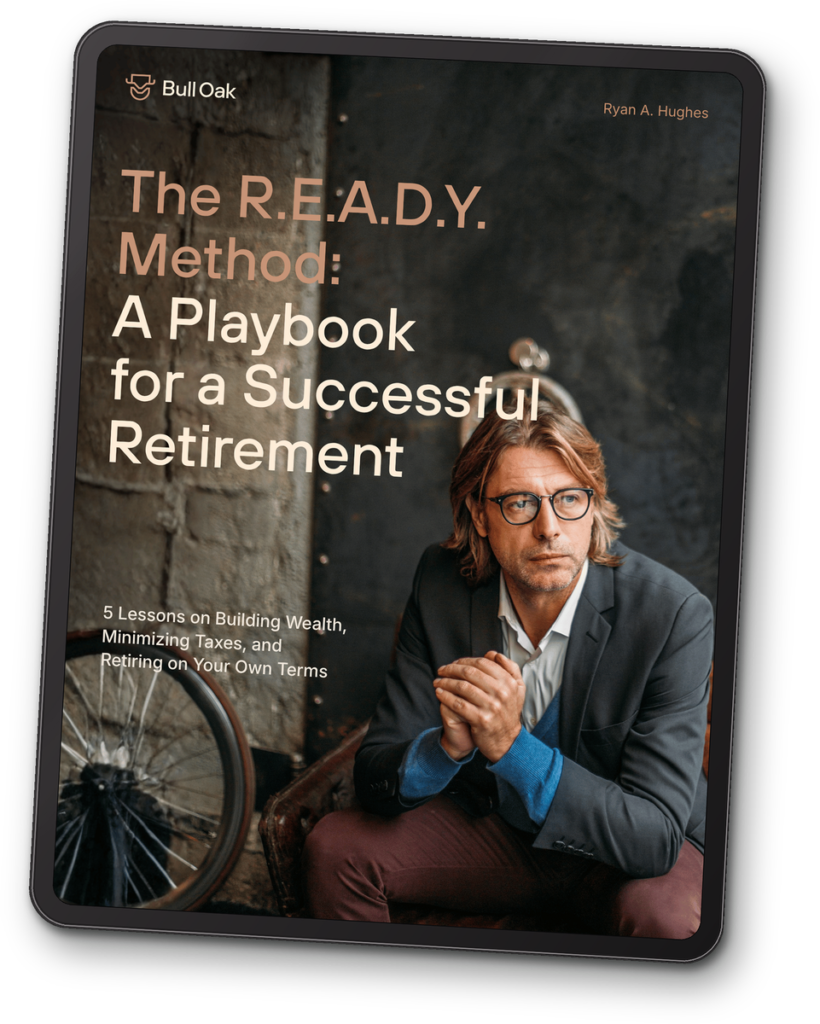
READY Method iPad Mockup

Are you retirement ready? Download our free 5-step guide on building wealth, lowering taxes, and retiring on your own terms.